
Choking
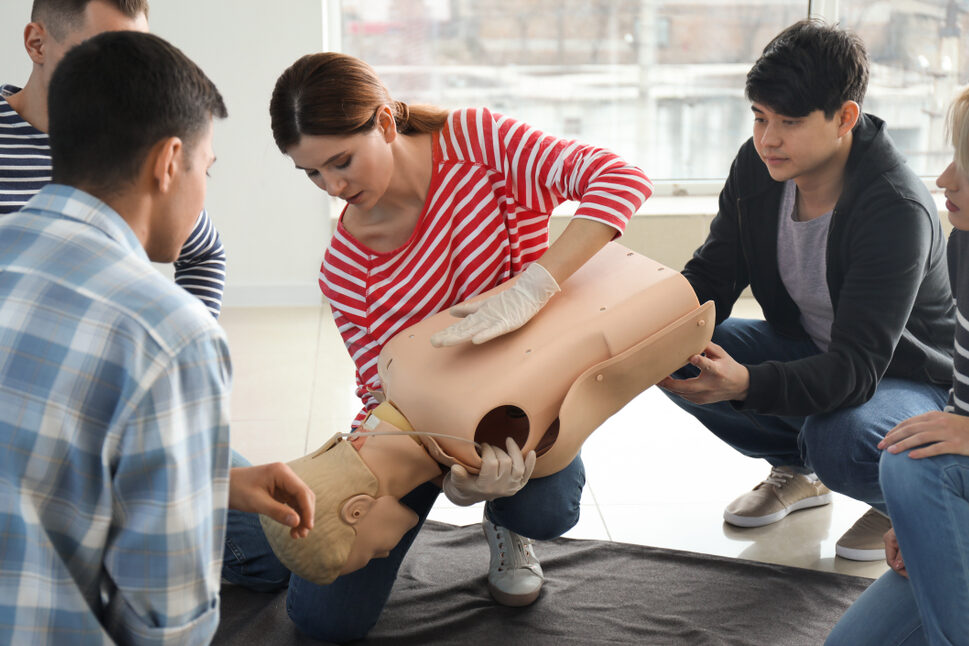
Dozens of people choke every year in Finland
Choking and strangulation are less common than other types of accidents. However, dozens of people still choke in Finland each year. There are even more close calls.
- Some deaths by choking are caused by medical conditions, but most often choking occurs during eating.
First aid for someone who is choking
-
Give a firm slap between the shoulder blades.
Stand behind the person you are helping and bend their upper body downwards. Hit them hard between the shoulder blades five times.
-
If necessary, call the emergency number 112.
If the hits don’t help, call the emergency number 112.
-
Continue first aid with the Heimlich manoeuvre.
Next, perform the Heimlich manoeuvre: Bend the person you are helping forwards. Place your hands around their diaphragm with your lower hand in a fist and the other hand on top of it. Pull quick and hard towards yourself and repeat the motion five times if necessary.
If the person becomes unresponsive, start CPR.
Source: Kotitapaturma.fi

If the person you are helping becomes unresponsive, begin cardiopulmonary resuscitation: 30 compressions + 2 ventilations.
Before ventilations, remember to always lift the person’s chin to open their airways and close their nostril’s by pinching, so that the air will flow into the lungs.
CPR for adults
-
Put the person you are helping onto a firm surface on their back and kneel beside them.
-
Place the heel of one hand on the middle of the person’s breastbone and the other hand on top of the first one. Keep your arms straight. Your shoulders should be above the chest of the person you are helping.
-
Press the breastbone 30 times in a piston-like motion at a rate of 100 to 120 times per minute.
-
After 30 compressions, open the airways: lift the person’s chin and tilt their head back from the forehead. Close the person’s nostrils by pinching, press your lips tightly around their mouth and calmly blow air into their lungs two times.
-
Continue cardiopulmonary resuscitation, alternating between 30 compressions and two ventilations, until a professional takes over, the breathing normalises or you exhaust yourself.
Source: Terveyskirjasto
What to do if you are alone and in danger of choking?
Food or an object can suddenly get stuck in your throat when you are alone. All of a sudden, you can’t breathe, and you may panic. When oxygen supply is blocked, you must act fast.
You have one to two minutes.
- If a piece of food or an object gets stuck in your throat and you can’t get it out even by coughing vigorously, your oxygen supply will be cut off immediately. Most likely you haven’t even had the time to prepare for the situation, and there isn’t that much air in your lungs. This means you have very little time to rescue yourself – in practice, between one and two minutes, at most. After that, you will run out of oxygen.
Seek help from other people.
- Under no circumstances should you stay alone. Think in advance where to go if you need to get help for yourself. If you live in a block of flats, immediately run down the stairs and outside and find the nearest person to help you. If you can’t get out of the building easily, at least leave your own flat into the stairwell and try to get the attention of your neighbours, for example, by banging on their doors. The most important thing is that you don’t stay alone where you are, or try to hide from others just to cough in peace.
Try to get the object out by running into something.
- You could try to help yourself by performing the Heimlich manoeuvre, but it is much more difficult to do on your own than when you’re helping someone else. You may be able to achieve the same result by putting your hands in fists on top of your own diaphragm and dropping yourself onto the back of a sofa or an armchair so that your diaphragm is hit. You can also achieve a hard impact on the diaphragm area by going into a push-up position on the floor and stretching your arms out straight so that you fall hard onto your stomach.
Source: Finnish Red Cross (SPR)
If you are alone and you cannot get the food or object stuck in your throat out by coughing vigorously, seek help from other people quickly.
In practice, you have approximately one to two minutes to rescue yourself. After that, you will run out of oxygen.
Instructions on how to report an emergency
-
Call the emergency number 112.
Only call in urgent, genuine emergencies when someone’s life, health or property or the environment is under threat or in danger. If you use the 112 mobile app, remember to make the call through the app. This way, your location information will be forwarded to the emergency response centre automatically.
You can also call the emergency number 112 using a foreign mobile phone subscription. Even then there’s no need to use a country or area code: just dial 112.
-
You can also send a text message.
If necessary, you can also report an emergency by sending an SMS to the number +358 112.
The use of emergency SMS messages is primarily reserved for individuals who cannot hear or produce speech. An emergency text message can only be sent from a pre-registered phone number. A number can be pre-registered on the Suomi.fi website.
-
Do not call or text the emergency number in the following cases:
if the situation is not urgent, if you have general enquiries or want to ask a question or if you are reporting a disturbance where no one is in danger.
Source: Suomi.fi