Collisions with animals
Statistics on accidents
- In 2022, there were nearly 14,000 accidents involving wildlife.
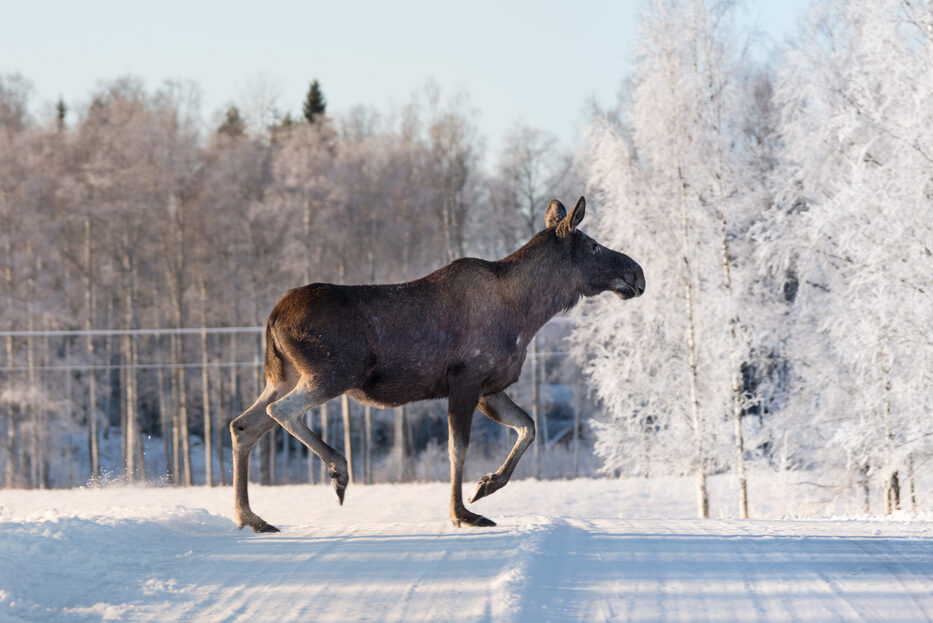
- There were 1,459 elk collisions.
- Accidents occur throughout the country, but most frequently on busy two-lane main roads and least frequently in the northernmost parts of Lapland.
- The risk of colliding with an elk or some other deer is great in areas where wildlife fences begin and end.
Source: Finnish Road Safety Council
Elk and deer collisions occur throughout the year. Deer collisions are particularly common in November.
When is the risk of an elk collision greatest?
Elk collisions often occur when there is some distraction, for example, poor visibility, oncoming traffic or poor weather conditions. The driver may also be focused on something else, making it difficult to notice an elk darting onto the road.
Reducing driving speed gives you more time to react to sudden situations and also mitigates injuries in the event of a collision.
- Elk and deer collisions occur throughout the year. Deer collisions are particularly common in November.
- Elks are most active during their mating season in October and November, and again in May and June, when female elks wean their yearling calves. These young elks are prone to straying onto roads, even in unexpected places where there are no traffic signs to give you warning.
- The majority of elk or deer accidents occur at dusk or in the dark, most often an hour after sunset.
Source: Finnish Road Safety Council, collisions with animals (in Finnish)
Why do elk collisions occur at dusk?
- Visibility on the road is poorest at dusk.
- Elks are most active during sunset.
- Elks move to their night-time feeding grounds.
- Elks dare to cross roads more boldly in the cover of dusk.
- Light, circadian rhythm and time of day may affect the alertness of the driver.
Reindeer move in herds
When you move in a reindeer husbandry area, you must always be prepared for the possibility of a reindeer on the road.
Reindeer are most active between July and August and between November and January.
Be alert if you see even one reindeer, as it is almost certain that there are more of them nearby. Reindeer are herd animals.
Instructions on how to avoid elk and reindeer collisions
- Reduce speed at an elk hazard area or if you see hunters near the road.
- When you drive in a reindeer husbandry area, reserve plenty of time for the journey.
- Use high beams already at dusk, so that you can see the eyes of the animal shining in the beam as a warning sign.
- Keep an eye on the roadside, especially in places where there are trees or bushes growing close to the road. Be particularly careful in bends and hollows.
- If an animal runs onto the road, try to dodge it from behind.
Source: Traffic safety
What should you do if there is an accident?
-
Warn other road users and place the triangular warning sign in the correct place.
-
Help and call for help if anyone is injured in the accident. Dial 112 to report an emergency.
-
Always report the accident to the police (even if no one was injured), that is, call the emergency number 112.
Move the carcass to the roadbed shoulder. Don’t take it with you.

Watch out for small animals that dart across the road
- From time to time, also small animals run across the road. Situations usually develop quickly.
- Always check the rear-view mirror before braking so that you don’t cause rear-end collisions.
- If you swerve to avoid hitting a small animal, avoid making sudden manoeuvres so that you don’t end up in a ditch or in the oncoming lane and cause a more serious accident.
- A driver who leaves their own lane is always at fault for any traffic accident that may occur.
- Each driver or motorcyclist can think in advance about potentially risky situations and how you should act in them.