Accidents

Every year in Finland, there are over a million serious or minor accidents, over 70% of which occur at home or during leisure time.
Boys and men suffer the most accidents.
Leisure-time accidents
- Accidents involving young people during their leisure time are often related to sports, traffic or other outdoor activities.
- The most common accidents at home or during leisure time in Finland are falls, slips and trips.
Substance abuse accounts for a significant proportion of accidental deaths
- The most common accidental deaths are traffic fatalities, falls and drops, drownings, poisonings and fire-related deaths.
- Studies (in Finnish) confirm a link between substance abuse and accidental deaths: over 7% of falls and 35% of other fatal accidents occur under the influence of alcohol.
– Over 50% of fire-related deaths occur while intoxicated, says Juha Hassila, Communications Specialist at The Finnish National Rescue Association (SPEK).
We all have an obligation to help in the event of an accident.
Everyone has the right to receive help.
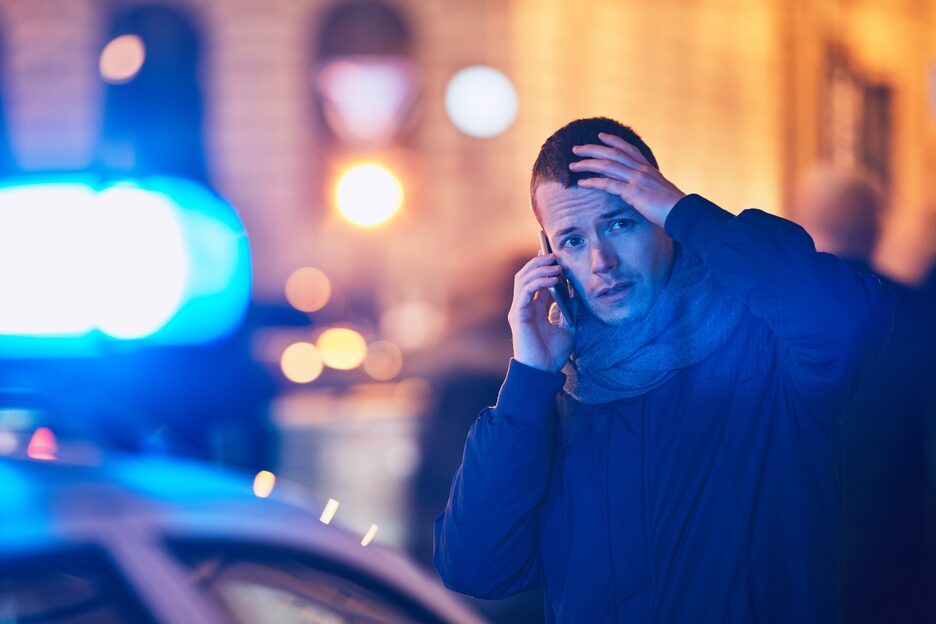
The Rescue Act stipulates that anyone who observes or receives information about a fire or other accident that is either occurring or about to occur and cannot immediately extinguish the fire or combat the danger is obliged to notify those endangered, make an emergency call and take rescue action without delay to the best of their abilities.
If you and your friends happen to be the first ones to arrive at an accident scene, don’t hesitate to take control of the situation. Do this:
-
The most important thing is to keep yourselves safe, so you don’t get hurt. Be careful of other cars, for example.
-
Save those whose lives are in danger. If, for example, the victim of the accident is in a burning vehicle, move them to the nearest safe place.
-
One of you should call the emergency number and another one should begin administering first aid.
-
Also warn others in the vicinity of the accident, such as other road users. Someone should stay behind to direct traffic. If possible, they should put on a reflective vest.
-
Other people at the scene can form a visual barrier around the accident site to protect the victim and ask people taking photos of or filming the situation to leave.
Emergency first aid for an unconscious person and cardiopulmonary resuscitation (CPR)
Do this when a person suddenly loses consciousness or appears lifeless:
- See if you can wake the person up by talking to them or shaking them.
- If the person does not wake up and is unresponsive, shout for help and ask someone who is there to dial 112 to report an emergency. If you are alone, report the emergency yourself. Put your phone on speaker and follow the instructions given by the emergency response centre.
- Open the airways: With one hand, lift the tip of the chin, and with the other hand, tilt the head back by pressing on the forehead. Check if the person’s chest is rising and if you can hear the sound of breathing or feel the airstream.
- If the person is breathing normally, put them in the recovery position and monitor their breathing until the professionals arrive. If the breathing is not normal, begin cardiopulmonary resuscitation.
CPR for adults
- Put the person you are helping onto a firm surface on their back and kneel beside them.
- Place the heel of one hand on the middle of the person’s breastbone and the other hand on the top of the first one. Keep your arms straight. Your shoulders should be above the chest of the person you are helping.
- Press the breastbone 30 times in a piston-like motion at a rate of 100 to 120 times per minute.
- After 30 compressions, open the airways: lift the person’s chin and tilt their head back from the forehead. Close the person’s nostrils by pinching, press your lips tightly around their mouth and calmly blow air into their lungs two times.
- Continue cardiopulmonary resuscitation, alternating between 30 compressions and two ventilations, until a professional takes over, the breathing normalises or you exhaust yourself.
Source: Terveyskirjasto
Help, don’t shoot!
Taking pictures and filming at accident sites jeopardises the privacy of victims and disrupts rescue operations.
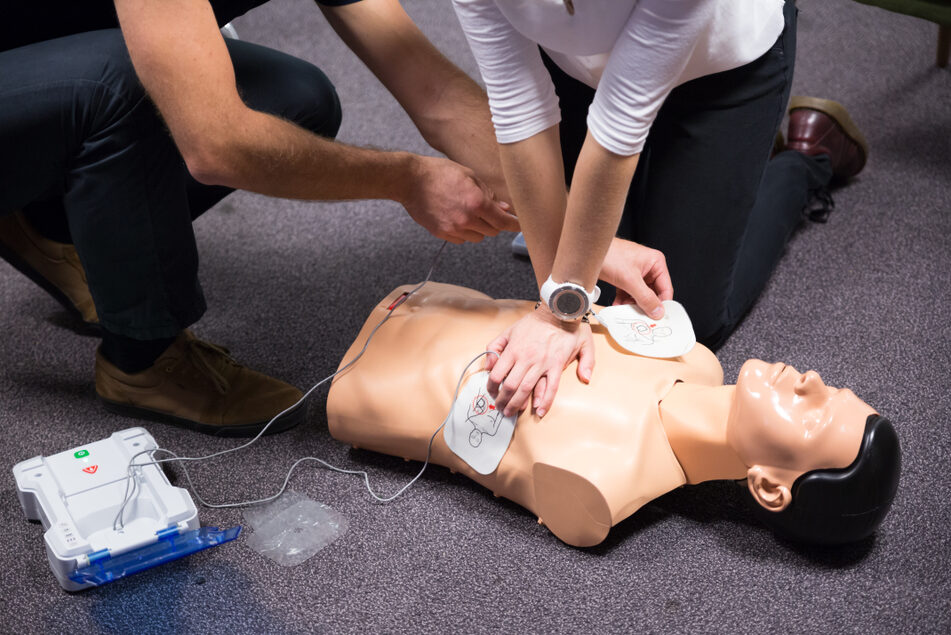
What is a defibrillator and what do you do with it?
A defibrillator is a device that, in the event of cardiac arrest, attempts to eliminate the harmful arrhythmia that has stopped the heart by delivering a direct-current electric shock to the person being resuscitated.
- If you find an unconscious person, first check if they react to attempts of being woken up: tap them firmly on the chest and ask them loudly if they can hear you.
- If the person does not react, call 112 to report an emergency.
- Lift the person’s chin / tilt their head back to open their airways. Check their breathing: get close to their face and check with the outside of your palm whether you can feel an airstream. If the person does not breathe normally, begin CPR: 30 compressions and two ventilations.
- While one person does CPR, the other person picks up the defibrillator.
- Don’t interrupt the CPR while the pads of the defibrillator are being attached.
- CPR must be continued until an ambulance has arrived and the professionals have taken over the situation, when the emergency response centre tells you to stop or the person doing CPR exhausts themselves.
Source: Mari Pylväläinen, First Aid and Health Information Instructor
The Defi.fi service allows you to quickly locate the nearest defibrillator when someone’s heart has stopped.
Find the nearest defibrillator on the mapDefibrillator facts
Is anyone allowed to use a defibrillator?
Yes, they are, and they should, if they see someone who is unresponsive and not breathing normally and there is a defibrillator somewhere nearby.
Can I mess up or cause harm with a defibrillator?
Don’t be afraid of using a defibrillator – you cannot mess it up! The device gives instructions to the user: it has voice prompts, visual instructions and lights that tell you what to do at each stage of CPR.
Does the defibrillator state where the electrodes need to be placed?
Yes, the pads have pictures that show which part of the torso they need to be attached to.
Can I get shocked while I use a defibrillator?
You cannot if you follow the voice prompts of the device. The device clearly says: ‘Do not touch patient. Analysing heart rhythm.’ If you touch the patient anyway, the defibrillator might analyse your heart rhythm instead of the patient’s rhythm. However, you still won’t be shocked.
When the device says: ‘Shock is recommended. Press the shock button. Do not touch patient,’ do as it says and let go of the patient, or you both get shocked.
What should I do if the chest of the patient is really hairy and the adhesive pads of the defibrillator don’t stick on it?
Most defibrillators come with a disposable razor for the removal of body hair. Before you attach the pads, shave the areas where the electrodes go.
Take action for safety – download the 112 Suomi mobile app!
Through the app, you will receive public safety alerts and notices directly to your phone. The app also provides instructions on how to prepare for various disruptions. The instructions can also be read in the app when the network connection is down, that is, in offline mode.
Download the free 112 Suomi mobile app
Instructions on how to report an emergency
-
Call the emergency number 112.
Only call in urgent, genuine emergencies when someone’s life, health or property or the environment is under threat or in danger. If you use the 112 mobile app, remember to make the call through the app. This way, your location information will be forwarded to the emergency response centre automatically.
You can also call the emergency number 112 using a foreign mobile phone subscription. Even then there’s no need to use a country or area code: just dial 112.
-
You can also send a text message.
If necessary, you can also report an emergency by sending an SMS to the number +358 112.
The use of emergency SMS messages is primarily reserved for individuals who cannot hear or produce speech. An emergency text message can only be sent from a pre-registered phone number. A number can be pre-registered on the Suomi.fi website.
-
Do not call or text the emergency number in the following cases:
if the situation is not urgent, if you have general enquiries or want to ask a question or if you are reporting a disturbance where no one is in danger.
Source: Suomi.fi