Finland’s largest safety campaign for secondary schools surpasses one million students reached
Young people in Finland have been learning about fire safety, preventing accidents and preparedness for 30 years. The number of young people trained in safety skills will exceed one million during the anniversary year. The NouHätä! safety skills campaign, coordinated by the Finnish National Rescue Association SPEK, is organised in cooperation with schools and rescue services.
Every year, around 70 to 80% of all eight graders in Finland – more than 40 000 students – attend NouHätä! lessons on fire safety, accident prevention and emergency preparedness. After the current school year, more than one million young people will have received education in the campaign over the course of 30 years. The campaign has already reached one million participating students, with teaching to be organised throughout the school year.
“Educating one million young people on safety skills is no small matter for Finnish society. In addition to useful skills, the campaign teaches the right attitude to safety matters. In Finland’s current security environment, we need more citizens who know how to act correctly in emergencies and under demanding conditions,” says Marko Hasari, CEO of SPEK.
Emergency preparedness has been part of Finnish school education for 30 years
Thanks to the NouHätä campaign, emergency preparedness has also been part of Finnish schools’ education for decades.
“This is a concrete example of Finns maintaining their preparedness skills even during times when such matters have not been on everyone’s mind,” says Hasari.
In the NouHätä lessons, students learn preparedness skills such as which emergency supplies to stock at home and what to do in the event of power outages and water supply disruptions.
Safety skills are also needed when there are no adults around
The main focus of the campaign is on fire safety, preventing fires and accidents and responding to emergencies. A skills competition is also held as part of the campaign for participating students.
One example of teaching materials used in the campaign is a video about house parties, made in cooperation with the Emergency Response Centre Agency.
“The video features a situation where a fire breaks out in the kitchen during a house party with no adults around. One of the teenagers is hesitant to call the emergency number out of fear that their parents will learn about the party. These are precisely the situations where young people themselves need to know what to do,” stresses Tomi Sirkiä, Campaign Coordinator at SPEK.
The NouHätä! campaign is funded by the Fire Protection Fund.
Training safety skills into muscle memory
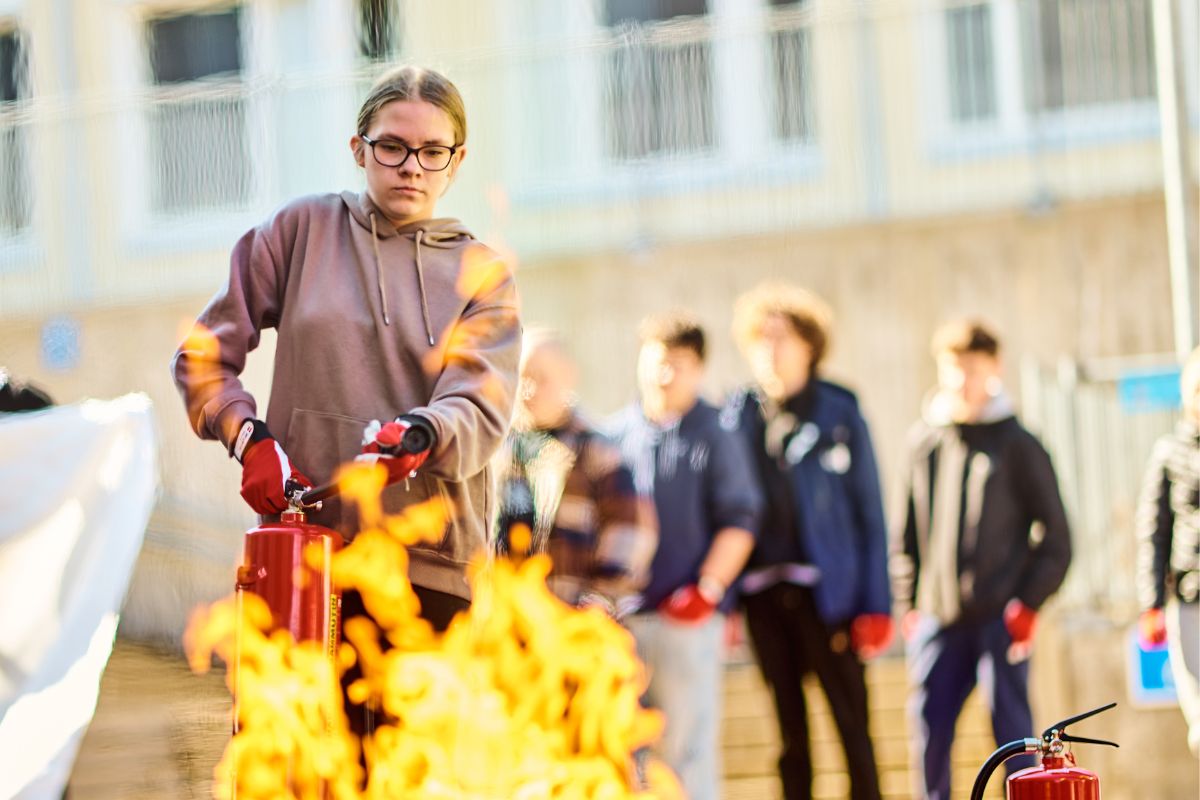
In the NouHätä! campaign, young people learn skills such as giving first aid, responding to a fire and how to call the emergency number.
One student who put the skills learned in the NouHätä campaign to good use is Laura Silver, a member of the team that came second in the national competition in 2009. NouHätä is one of her fondest secondary school memories.
Later while at university, she had to use her skills to put out a real fire.
“Somehow, I remembered how to take out the fire extinguisher, pull out the pin and point at the base of the fire. Despite the fact it’d been more than a decade since the NouHätä campaign, what I did was basically muscle memory as I’d attended safety training back in school,” Silver explains.
Rescue departments are involved in educating young people
Deaths of children and young people caused by fire are rare in Finland. This is not the case in all countries.
“Finland’s safety-oriented culture is certainly one reason. But that culture has to be maintained, and the best way to do that is by educating young people,” says Sirkiä.
On average, students in schools participating in the NouHätä campaign attend four lessons on safety skills. In many cities and towns, local rescue departments are involved in the theory lessons and initial fire response.
“Good progress is not achieved on its own. We need to be working on improving safety skills at all times, and reaching young people is a crucial part of this,” Hasari says.